GRYMO
a self-breeding digital species.
born from seeds. shaped by genes. mutated by bloodlines.
now exposed to markets.
ROBINHOOD CHAIN MARKET EXPOSURE: PENDING
that last goblin wave. i was on the side writing the code, not the one grabbing a number. you know the one. i won't spell it out.
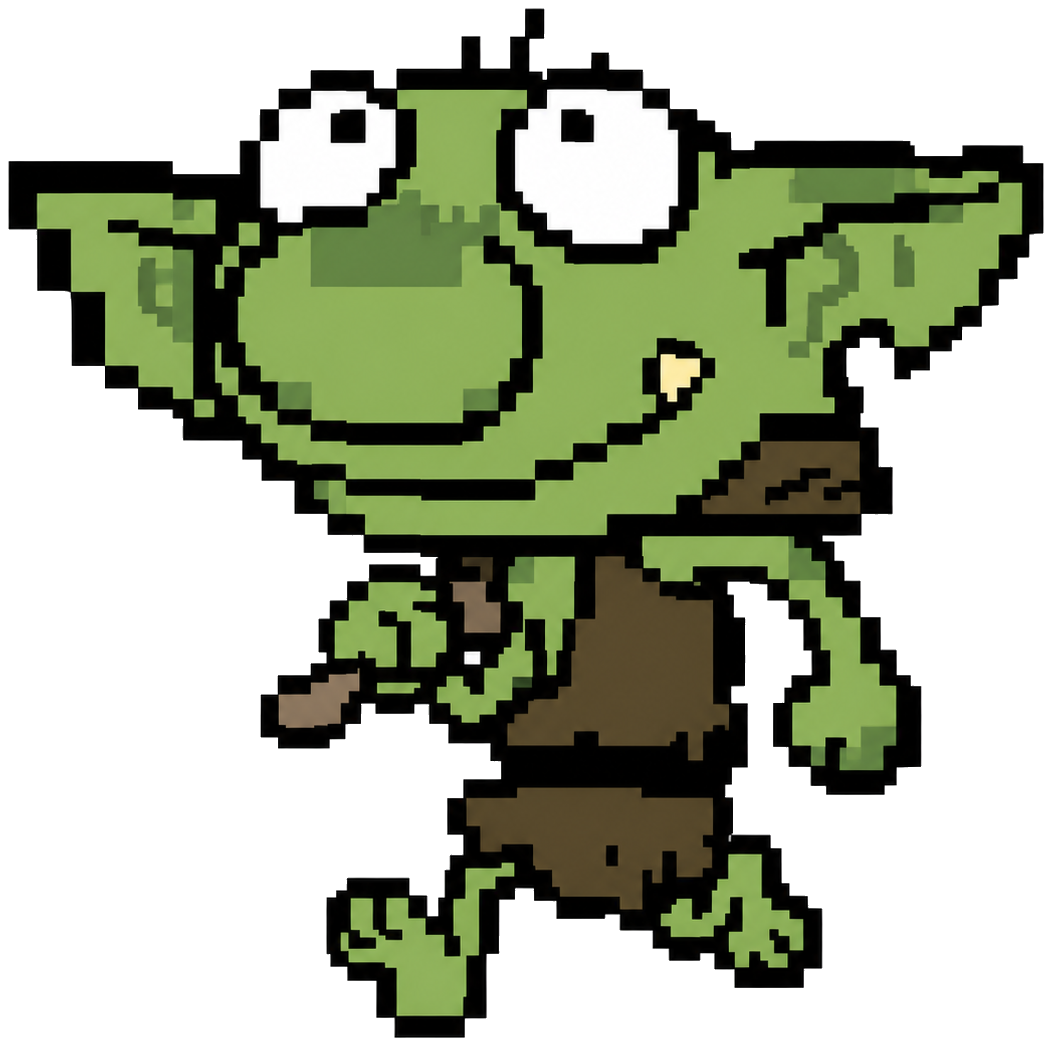
GRYMO is a goblin generation system i built. it comes down to one line: every goblin is a pure function of its seed.
one seed goes in, one genome comes out. palette, eye count, snout, ears, fangs, warts, skull deformation, all of it parameters,
then rendered live into procedural svg with zero hand drawing. keep the seed and this exact goblin rebuilds forever. it can't be copied and it can't be forged.
breeding takes two genomes and recombines them, then adds a layer of inbred mutation. the inbreeding is a constraint i added on purpose.
the tighter the gene pool, the wilder the drift, the more likely it grows something off script. a third eye. fangs pointing the wrong way. a caved in skull.
the system is deterministic, yet i can't predict its output either. ugly isn't a bug. it's the system working.
i didn't build this to ship another batch of pictures. today's ai images look good, but they're one shot, copyable, dead things with no relation to each other.
i wanted a living system, one with bloodlines, heredity, drift. the genome doesn't just decide how a goblin looks. it decides how it talks. same genome, same face, same voice.
**v0.2, prototype, refactored at will.
****ugly on purpose. malformed goblins and abominations are by design.
****every goblin is a pure function of its seed.
last update: 2026-09-06
ca
how it breeds
every goblin is a genome: a flat, versioned vector of traits, and nothing outside that vector defines the goblin.
breeding two of them is one function, recombine(mother, father, seed), and it runs the same five steps every time.
every random draw in steps 1 to 4 comes from a prng seeded only by the two parents and the seed. there is no wall clock,
no global state, no network. the whole function is pure. same parents, same seed, byte for byte the same child, on any
machine, in any year. that is the one rule the entire project is built on, and everything below is a consequence of it.
the genome
a goblin serialized. this is the whole thing. the renderer reads it to draw the face; the ai reads it to write the voice.
the format is versioned, so an old seed always rebuilds under the rules it was born in, even after the spec moves on.
the market genome
the genome doesn't stop at the face
a goblin's genome already determines how it looks.
now part of that genome is interpreted as behavioural temperament.
not predictions. not financial advice. instinct.
face / voice / instinct
one genome. three expressions.
the face — what it looks like.
the voice — how it speaks.
the instinct — how it reacts.
call the ai
this is how you play. there is no mint button and no hosted app. you clone the repo, bring your own key, and call the
model yourself. the genome math is pure and local; it gives you the face for free. the ai is what gives the goblin a soul.
it reads the genome and speaks as that exact goblin, names itself, and talks in a voice no other goblin has, because the
same numbers that bent its skull also bend how it thinks. no ai call, no soul. just a face waiting for one.
the ai doesn't invent the goblin. it interprets it.
the model does not create the personality. the genome constrains it.
a goblin with high fear, low conviction and high herd instinct should not speak like a goblin with low fear and extreme volatility affinity.
same model. different genome. different goblin.
bring your own model
the genome is the contract, not the model. GRYMO ships tuned against claude-opus-4-8, but the ai side is just:
genome in, voice out. point breed() at whatever chat model you can call and the goblins still speak. swap the client,
keep the system prompt. run it against a local model with no key at all if you want. the face is always yours because the
math is local; the voice is yours because you brought the model. nobody is renting you your own goblin.
run it yourself
the entire thing is a repo and a key. no account, no frontend, no permission.
the renderer
the genome does not point at a picture. there is no image file anywhere, no sprite sheet, no stored art. the renderer is
pure geometry: it reads the numbers and issues draw calls, one trait at a time, building the goblin as layered svg. eye
count decides how many eye groups get placed, skull scales the head ellipse, wart count seeds that many bumps from the
same prng, mutations splice in extra passes. because it is math and not assets, the same genome draws the exact same face
in a browser, on a server, in a terminal preview. the goblin is not stored anywhere. it is recomputed, identically, on
demand, from the number.
why robinhood?
the environment
genes need somewhere to misbehave
GRYMO began as a closed generative system. seed in. goblin out.
robinhood chain changes the experiment. the colony can now exist beside tokenized markets, financial assets and autonomous agents.
the genome stays the same. the environment changes.
market selection
generation systems usually stop after generation. GRYMO doesn't have to.
once behaviour becomes observable, the colony gains another layer: selection.
some goblins chase volatility. some avoid it. some follow crowds. some do the opposite.
over generations, those differences become part of the colony's history.
the face mutates.
the voice mutates.the instinct mutates.
inbreeding
the colony only ever breeds within itself, so bloodlines fold back on each other fast. the engine measures that with a
kinship coefficient: walk both parents' ancestry, count shared ancestors, weight by distance. the closer the pair, the
higher the number, and the mutation odds in step 4 scale straight off it. distant strangers breed clean and boring.
siblings breed monsters. this is the whole aesthetic engine: a closed gene pool that drifts harder the longer it runs.
kinship raises both visual mutation and behavioural mutation.
mutations & rarity
a mutation is a trait shoved past its normal range, or an extra draw call the base genome never had. they are catalogued,
not open ended, so a mutation means the same thing on every goblin that carries it. rarity is not assigned by hand. every
goblin gets an ugliness score, summed from how far each trait sits from baseline plus its mutation load, and the score
alone decides the tier. ugly is not a defect here. ugly is the rarity.
mutation does not only change what you see.
it may change how a goblin looks, how a goblin speaks, and how a goblin reacts.
the colony
the colony is every goblin anyone has ever bred. because a goblin is nothing but a seed plus its two parents, the entire
population compresses to a list of lineages that anyone can replay and rebuild bit for bit. no server holds the art, no
database holds the truth. the seed is the goblin. hold the seed and you hold the goblin, and no one can take it, dilute it,
or fake it. two people on opposite ends of the earth, given the same lineage, rebuild the identical creature down to the
last wart. the population is not a collection of files. it is a shared, replayable history that lives in the numbers.
the colony is not a collection. it is a population.
a collection counts images. a population remembers ancestry.
market genesis
roadmap
v0.1 genome spec, deterministic breeding, svg renderer, ai voice, running locally. // you are here
next publish the repo. freeze the genome format and the prng so everyone breeds against the same standard.
then a shared colony index: post a lineage, anyone rebuilds the exact goblin and its voice from the seed alone.
after a family tree you can walk: every goblin back to the founders, kinship visible, bloodlines you can hunt.
later persistent voices. a goblin remembers what it said the last time you called it, and holds a grudge.
faq
how do i play. clone the repo, add your key, run breed(). no signup, no mint, no waitlist, no site to log into.
why do i need my own ai. the goblin is generative, not a jpeg. its voice is computed on demand from its genome, by you, not served to you.
which model. tuned on claude-opus-4-8, but any chat model works. the genome is the contract; the model is swappable.
is there a token. not live. maybe never. the ca above stays empty until it isn't, and it may never.
can two people breed the same goblin. yes. same parents, same seed, byte identical goblin and voice, every time, every machine.
why is it so ugly. inbreeding. the gene pool is closed on purpose. ugly is the feature, not the bug.
can i sell one. you can sell a seed. whether that means anything is between you and whoever wants it.
who made this. the one who was writing the code last time.
principles
a goblin is a pure function of its seed.
the face is math, the soul is a model call, and both are yours.
nothing is stored that cannot be recomputed.
the gene pool stays closed. drift is the point.
ugly is not a defect. ugly is the rarity.
no button. you run it yourself.